Global Short Drama Weekly Brief
94 of China’s Top 100 short dramas are now AI-generated. The question is no longer whether AI can make content. It is whether humans can still make money from it.

Omdia: ReelShort Overtakes Major Streamers in Daily Mobile Engagement
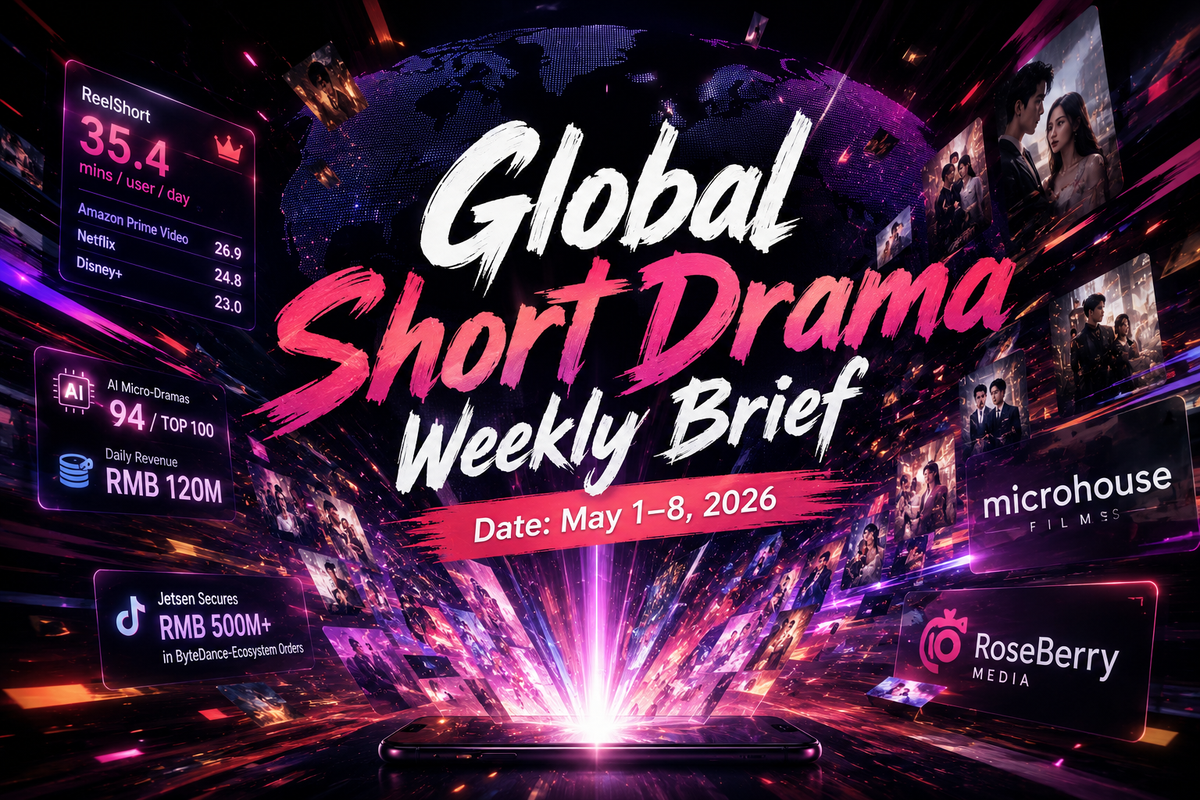
What happened: Research presented by Omdia at the Digital TV Summit in London on May 6 pointed to a sharp shift in U.S. mobile viewing behavior. Based on Q4 2025 Sensor Tower data, summit coverage said ReelShort reached 35.4 minutes of daily mobile viewing per user. By comparison, Amazon Prime Video averaged 26.9 minutes, Netflix 24.8 minutes, and Disney+ 23 minutes. In other words, ReelShort has moved ahead of several major streaming platforms in mobile engagement.
Why it matters: The most important signal here is not that micro-dramas have already beaten long-form streaming platforms on scale. The real shift is that this format is now holding a clear edge in attention intensity on mobile, and that could fundamentally rewrite the logic of competition. For content platforms that want to aggressively lock in user attention time, short drama could very well become a moat in the next round of content competition.

AI Micro-Dramas Take 94 of the Top 100; Reported Daily Revenue Reaches RMB 120M
What happened: Reporting published on May 7 said that, based on data through April 2026, AI-generated micro-dramas have become the dominant format in China’s short-drama rankings. According to the cited platform and industry data, AI titles occupied 94 of the Top 100 by April, up from just 4 titles in the Top 5000 in early 2024. The same reporting said Douyin had roughly 180,000 AI short dramas in circulation, with reported daily gross revenue reaching RMB 120 million.
Why it matters: China’s AI short-drama market may have already moved beyond the stage of “AI penetration” and into a different phase, where scale itself is becoming the main story. That shift could fundamentally rewrite the logic of competition. The next advantage will no longer belong to the people who learned the tools first, but to those who can industrialize taste, distribution, and profit all at once; otherwise, the stronger AI supply becomes, the faster audience fatigue and content devaluation will arrive.
Jetsen Locks in More Than RMB 500 million (about $73M) in ByteDance-Ecosystem Orders
What happened: According to its Q1 2026 earnings and business update disclosed in early May, Jetsen, the parent company of Huashi Wangju, confirmed a major escalation of its AI business. The company said it had formally secured more than RMB 500 million in short-drama orders from the ByteDance ecosystem. In addition, Jetsen is preparing a concentrated content rollout, with more than 20 AI comic dramas expected to launch in May and June 2026.
Why it matters: This suggests that the competitive focus in AI short drama is shifting from model capability to delivery capability. More importantly, confidence in AI content from a mothership-level platform is becoming unmistakable through the emergence of large orders like this. That is far more convincing than any verbal claim that live-action film and television content still matters more.